
Building a Future-Proof Workforce
In the previous article on OpenClaw, I introduced the agentic engineer. The person who holds the full agentic stack in their head and deploys it in real conditions.
That role is the first of a category, not the only one in it.
The category is the domain expert who codes. The experienced people who can be reskilled. Who still hold the domain. Who now ship at a different scale. Who became the design engineer, the marketing engineer, the finance engineer, the agentic engineer. Roles that did not exist as job categories two years ago and are quietly forming today.
That category requires leaders who can see beyond the myth of technology.
Coding Is the Easy Part
Boris Cherny, who created Claude Code, recently said software is becoming like literacy. A capability any working professional can carry, not a specialised skill reserved for engineers.
His reference point was the printing press. Before it, around 10% of Europeans were literate, mostly working as clerks for kings and lords who could not read themselves. After the press, global literacy eventually reached around 70%. Reading stopped being a profession and became a baseline.
Coding is heading the same way. Engineers do not disappear. Everyone else picks up the tool.
Is Coding Now Literacy?
Ask who is the best person to build accounting software? Cherny was direct about this. The best person to build accounting software, he said, is not a software engineer. It is a really good accountant. Because the domain knowledge is the hard part. Coding is now the easy part.
This flips a twenty-year assumption. For most of the digital era, the domain expert briefed the engineer. The engineer built the thing. The domain expert reviewed it. Iterated. Approved. Shipped.
The bottleneck was the engineer. The engineer was scarce, expensive, and had to be persuaded to care about a domain that was not theirs.
That bottleneck is now dissolving. Not because engineers stopped mattering. Because the cost of producing working code dropped to a level where the domain expert can hold the keyboard themselves.
Cherny described the Claude Code team in Anthropic. Engineering manager, product manager, designers, data scientist, finance, user researcher. Every single person in the team writes code.
That is the structure worth paying attention to. Not because Anthropic is unusual. Because Anthropic is early. The shape of that team today is the shape that AI-native companies are already replicating.
The Workflow Has Changed Underneath
In late April, Salesforce announced it will hire 1,000 graduates and interns to build a new workflow. This came two months after the company laid off nearly 1,000 employees.
Read beyond the fire-and-rehire headlines and the move says something specific. The workflow has changed underneath. The roles that existed before were designed for a pre-agent operation. The roles being filled now are designed for an operation where AI agents handle parts of the work. New tasks. New checkpoints. New ways to organize the day.
Fresh graduates are not being hired because they cost less. They are being hired because they arrive without the predisposition that shaped the old workflow. The new mindset is what drives the new workflow into existence. This is no longer a forecast. The agentic workflow is happening on the hiring boards now.
Who Gets Reskilled
If you believe AI is meant to augment value, then reskilling is how that promise gets kept. And reskilling is two groups, not one.
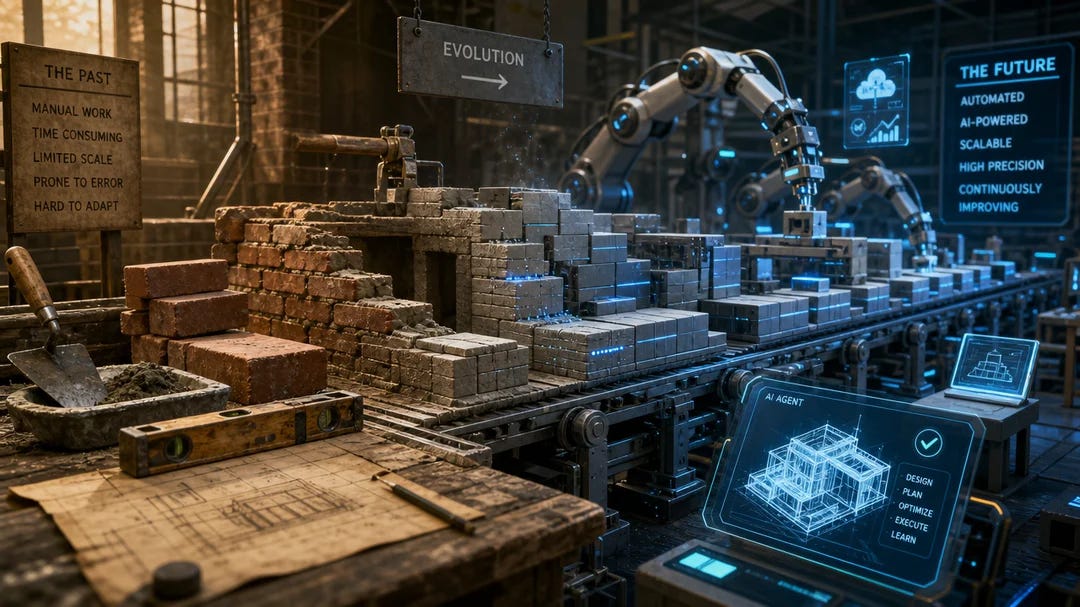
Domain experts carry the experience. They know which workflows mattered, which tasks deliver value, which decisions cannot be handed to a machine. Equipped with code, they become the authors of the new workflow. Their experience does not become obsolete. It becomes the foundation the workflow runs on.
Fresh graduates bring the mindset. They arrive without the predisposition that shaped the old way. They operate the new workflow the experts authored.
Apart, neither group is enough. Cutting seniors leaves the workflow without authors. Hiring graduates alone leaves them operating tools without context. This is the same trap schools fall into when they teach how to operate AI without the domain knowledge to direct it.
Together is where AI augments value instead of subtracting it. New work emerges that neither group could have produced alone. That is the augmentation AI was supposed to deliver.
The Gaps Between Now and Then
Knowing where this is heading is not the same as being ready for it.
Three gaps are still open.
Code as a disposable service. The idea that every domain expert produces and discards code on demand only works when AI coding intelligence is reliable enough to make that disposability safe. The trajectory is fast. The reliability is not there yet.
Infrastructure to deploy what gets built. When marketing produces an agent and finance produces a model and design produces a prototype, the infrastructure to host, version, secure, and monitor all of it has to scale with them. Most organizations are well behind on this.
Management practice. When a workflow runs on dozens of micro codebases authored by domain experts across functions, the question is who owns what, who maintains what, who decides when something breaks. The old management hierarchy has no answer. Reinventing it is harder than any of the technical gaps because mindset is involved, not just tooling.
Boris Cherny described how the Claude Code team operates. He did not explain how Anthropic made that team possible. The environment that allowed it is specific to their company, their hiring, their culture. It is not a template other organizations can copy. It is something each organization has to build for itself.
That is the work most leaders still avoid. The technology is moving. The workforce is shifting. The management model is the part that has not caught up.
All working together. Not one without the other.
