
Most Companies Still Run AI on One Cheap Chatbot
The AI story keeps colliding with reality. You read the headlines every day: AI adoption is exploding. A company left a model running and burned $100 million in tokens in a month. SaaS is dead. Coding is solved by AI agents. AI is replacing entire teams. Token spending has no ceiling.
Ramp, a US financial technology company that builds corporate expense management software, publishes a running index of how US companies actually pay for AI. The data skews toward tech-forward companies. I find it insightful because these companies may show what the rest of the market will look like in a couple of years.
Here Is What The Data Shows.
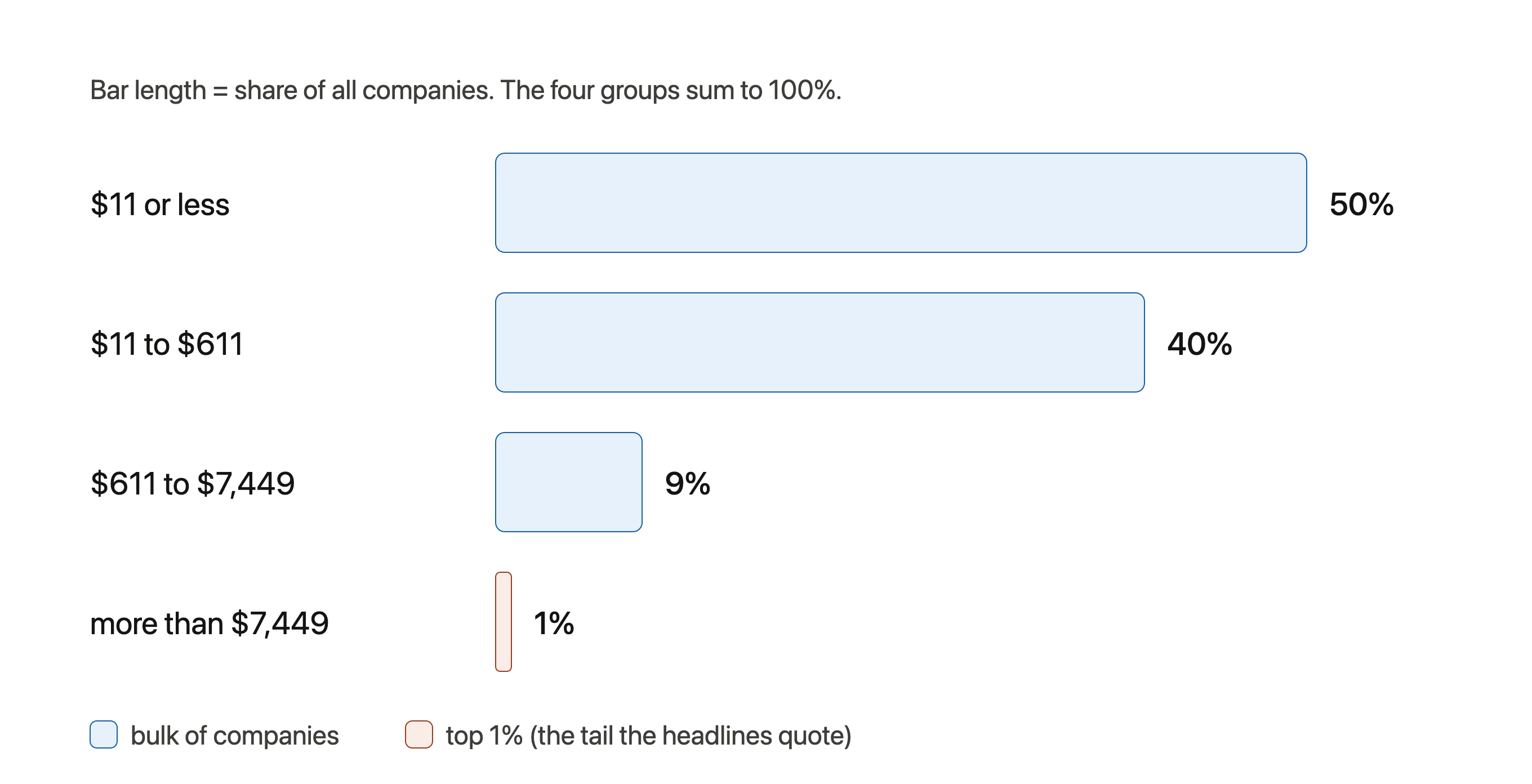
The spread is extreme.
The top 1% of companies spend $7,449 per employee per month on AI. Software engineers at those companies run roughly double that. The top 10% spend $611 per employee per month. The median company spends $11. That is one low-tier AI chat subscription.
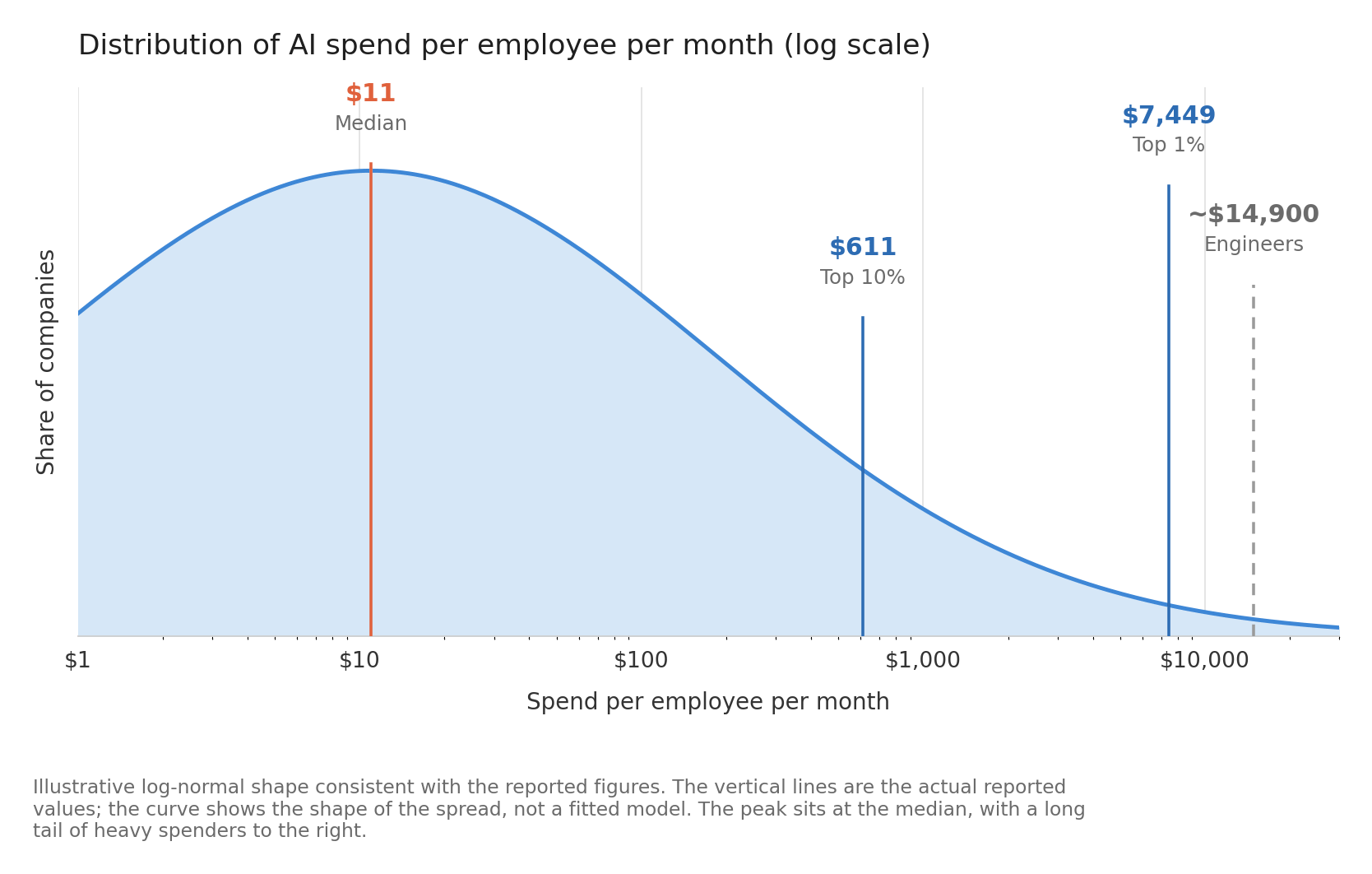
Three groups, three completely different realities, all inside the same economy. The $11 figure is the one to sit with. The typical company is not maxing out its token spend. It has barely started.
This also kills the token maxing narrative. Token maxing was the idea that companies should spend as much as possible on tokens. If that were real, you would see spend rise and then fall. The data does not show that. Every tier is still climbing. There was no peak to retreat from.
What This Means For You
Find where you sit on the curve, then ask the question the spend alone cannot answer: is this money buying capability or a subscription? A company at $11 with a single tool does not have a budget problem. It has a practice problem. Telling those two apart is the work, and it is the part a tool vendor will never do for you.
What separates the top is not budget or access. It is discipline. The people getting value do not treat one chat window as the whole of AI. They use several tools and send each task to whichever one handles it best. They give clear direction and check what comes back against what they already know. The median opens one chat window and takes whatever answer it gives.
There is a cost-control gap underneath all of this, and it points the same way. About 80% of the model vendors’ business revenue is token-based, and they have built almost nothing that helps you control that spend. The discipline will not come from the AI vendor. It has to come from the practice you build, not the platform you buy.
The $11 company and the $7,449 company are separated by practice, not money. The same is true of two people doing the same job. One uses AI to think. The other uses it to skip thinking. The work can look identical, until the moment someone has to defend it.
What AI at Work Can Learn Here
The AI educator Andrew Ng described this directly at a recent developer conference. A year ago he wrote about the product management bottleneck: when building software gets fast, the slow step becomes deciding what to build. A year later, he says, that bottleneck got worse, and it did not stop at product. When software gets built 10 to 100 times faster, almost everything downstream becomes a bottleneck.

Why There Is No Universal Fix
When every stage becomes a bottleneck, the problem is the operational chain, not any single step. And AI does not relieve a chain evenly, because AI is a generalist.
It is broad by design, trained on everything and expert in nothing in particular. That breadth is why it looks like a universal catalyst you can point at any department. But breadth is not depth. A generalist can draft a marketing email or a first-pass terms of service. It cannot run the agentic operation of a compliance review or a credit decision without the rules, edge cases, and judgment that live inside that function and nowhere in its training.
So the acceleration is uneven, and predictably so. AI clears the generic stages and stalls at the specialized ones. The bottleneck does not settle at random. It collects where the most domain expertise is required, which is exactly where Ng saw it land: legal, compliance, the work that carries consequence. The cascade ends at the domain experts.
Which is why the consultant’s hardest task is also the most valuable. No deployment lifts every department at once. Each function has to encode its own domain before a generalist can operate inside it. The universal catalyst does not exist. The domain expert who can teach the generalist that corner of the work does.
The Foundation Is the Point
There is no universal fix. The foundation is the part most companies skip.
The $11 is not the problem, and spending more is not the answer. The mistake is what the $11 buys: quick answers, typed into a chat window and forgotten. That is the lowest use of AI, and 50% of companies are doing exactly that. It produces a reply and leaves nothing behind. No benefit. No growth.
Spend the same $11 differently and it becomes a baseline. Point it at planning. Use it to classify your data, surface what you actually have, and turn scattered information into insight you can reuse. Each session should leave something the next one builds on. That is not a quick answer. It is a foundation, assembled gradually, that any later redesign will stand on.
This is the work an AI at Work consultant should lead. Not a workshop full of jargon. Not a class on how to prompt. Prompting is the easy part, and it ages out with every model. Teach a company to prompt and you have trained an operator for this quarter’s tool. Help it build the foundation and you have given it something the next bottleneck cannot take.
The companies at $11 are not behind because they spend too little. They are behind because they treat AI as an answer machine instead of the start of a system. The ones that pull ahead will not be the biggest spenders. They will be the ones who built a foundation while everyone else bought answers.
